Sunday, October 10, 2010

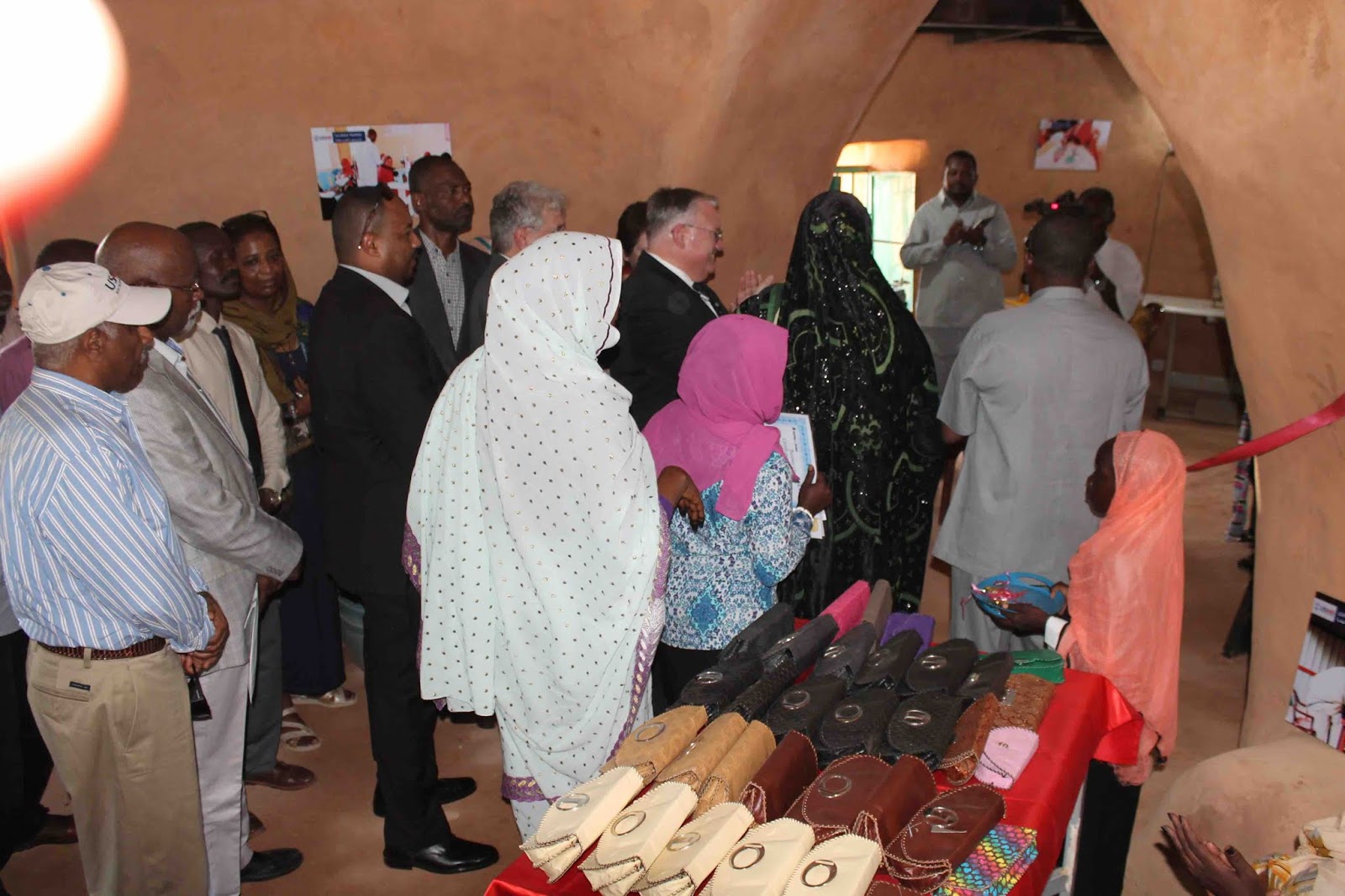
2010 New Faces


Young Ethiopians from HS4S Founder's trip to ET 
 
Taking inventory from the last four years, HS4S has some remarkable achievements unter its belt.  With less than 100,000 dollars, we have built four domes: one in Khartoum, one in Tonj, South Sudan, one in Nyala Darfur, and now, one in Djibouti.  But, even more significant than dome building, over 100 professional Architects, Engineers, contractors and IDPs know how to build the domes on their own.


Southerners add thatched look to Khartoum Dome
 Some of our partner architects in Khartoum have continued work on the teaching dome!  They hired Southerners to plaster the dome - and the Southerners have made it look like a thatched house in the South!  Our NGO partners in Darfur would like to build on a larger scale, but we are waiting for some of the Darfur expats and donors to bring in the funds for the Darfur community! In the mean time, our HS4S Founder and CEO is working in Djibouti on an academic advisory team.... So, while we all must work nowadays some of our Civil Affairs guys and gals who are working with the Djiboutian locals and the military think the domes are a great idea.  The local Red Crescent in Djibouti would also like to learn how to build the domes, so one of the Civil Affairs teams took up the challenge - found some sandbags and cement on the camp - and built a dome!  They did an amazing job! Since it was around 120 degrees every day, and it was during Ramadan, they built all night long! Two of the troops had the priviledge of attending the Calearth (http://www.calearth.org/) class in September and have some ideas on how to make the domes work in Djibouti.


Volunteers and CA work on Djibouti Dome
Last but not least, HS4S has a new person on board helping us!  The former CEO of S.T. Dupont in Paris has taken up the challenge of sharing real knowledge with the Sudan and partnering with us and our Sudanese Partners!
We are praying that the referendum passes peacefully and that with some solid donations we can take our nascent workers trained in the Sudan and start re-building on a larger scale.  As our Calearth architect said... 'it would be nice to build something other than a prototype for a change'!

Saturday, January 30, 2010

December 2009 – First Khartoum, then DARFUR – finally!!!

 (Housing for little darlings like these - the future! - picture of Darfur children taken by Hooman )
     YES, the phoenix factor was in full force by the end of 2009.  Though we arrived back in Khartoum to find that our dome was still standing in the International Friendship Park... we had to admit that it looked rather sad. Nevertheless, we all agreed that Allah had preserved the dome.  Kate had made a great start with the
dome in July 2007.  Ted and Steve brought it well past the halfway point in December 2007.  Hooman finished it with the collective help of an organization that had helped us in 2007 (Newtech), some of Kates students from 2007, and some private and public contractors who are interested in using the methods in the South of the Sudan and in Darfur.  Maha and her mom donated enough active lime and cement to finish the dome!
      Fakhr Aldin brought his 'guy' to fix the cement mixer that had been standing for two years in the mud and the rain.  Frankly, we don't know why it was still there, nor from where it came - so we attributed this to God also and were extremely thankful-
both for the mixer, and for those sent to help us finish
the dome!  It was great to work with Hooman who has a deeply spiritual side - so we could agree that some things can only be explained as 'God's help'!
     The University of Khartoum, Sweden House and one of the Technical Colleges asked us to lecture - so we gained some new allies and disseminated knowledge to those who are now capable of tending to the 'quality control' aspect of the buildings. 
As is evident from our 'first attempt' at a very large dome (18 ft in diameter and about 21 ft high) - many hands made for an odd looking structure.  It is a testimony to the strength of the material that it worked anyway.  Our later dome in Darfur is much prettier.  This one will be much more beautiful after it is plastered and the doors and windows evened out.   The lime and 'cotton soil' mix for the first 3/4 of the dome actually worked.  The material was a bit unwieldy and sticky - making it difficult to fill the sandbags - but nevertheless, if that is the only material available - it can be used!  Our initial batches of lime were not very active, so we used 15%...  After we found truly active lime, we reduced it to 5% and mixed the cotton soil with rough and smooth sand.  These materials are readily available and also quite cheap. 
     We worked about 10 days on the Khartoum dome - [well, Hooman did, - and I was off doing things like renewing our license, asking for permits to Darfur and other such support matters] and we took off for Darfur. We left the finishing touches for Khartoum in the capable hands of Mohamed,  'Aderope', the newly trained laborers, and several of Hooman's student fans.  We were stoked to see it finished when we got back! 
   [At the Technical College in Darfur:  Hooman (in hat) pictured here with some of the IDPs (one was an engineer), Professor Safi, and an engineer from the South who helped tremendously with the translation.... ] [The traditional houses built with wood and straw are pictured below.  John Mendlein, one of our board members who accompanied us on the visit to Darfur in June, took this picture near the site where we would like to build our clinic in 2010]
Thanks to Hashim (our long time partner who is now head of AFAG organization for Peace and Development) and the Technical College in Nyala, our workshop was already set up for us when we got to Darfur.  Dr. Mohamed - from the FAO had introduced this idea to teach the students and the IDPs a couple of years ago and we had set up the verbal agreement in September.  The Dean of the College and one of the professors - Safi - organized a class with 25 engineering students, several IDPs from Kalma Camp, and several local small contractors.  El Safi made sure that the materials were purchased and in place, and that we got the best possible prices in Darfur.  Not easy since at best, the prices in Darfur are DOUBLE everything in Khartoum.  Nevertheless, the materials for the small dome were less than $2000.  This is much less than it would cost to build a concrete and steel structure, and much more stable than the traditional houses being rebuilt with the straw (one cannot but think of that famous fairy tale when looking at the straw houses - beautiful, but fragile). Besides, there isn't much wood in Darfur.... Imagine if a million IDPs came out of the camps all at once and cut down trees to rebuild their burned houses...  Darfur would look like the moon.  In anycase, we could see the wheels turning in the minds of the IDPs and the engineers...  THIS type of building IS POSSIBLE in Darfur. 

 [The Darfur Esprits de Corps between the students, IDPs and contractors was pretty amazing and went beyond all of our expectations.  Hooman was great for for rallying the troops and working on his Arabic!]
Material wise - we bought about 2 1/2 metric tons of cement in Nyala for around $1000.  We found barbed wire manufactured by the Chinese for reasonable prices and Hooman brought 400 meters of sandbag from Calearth on the airplane from California all the way to Darfur. We bought polypropylene flour sacks at the market for $0.50 each and soap sacks (used for part of the roof) for around $0.20 each. We are certain that they can be found cheaper than this and some of the merchants are planning to manufacture the bags - uncut - in the old fabric mills in Nyala.  This would be really great.  Hooman taught the students and IDPs how to do simple soil testing to see if lime might work better than the cement.  Lime is locally mined in Darfur and available.  The possibilities for cheaper, locally available material is extremely empowering for them along with their newly acquired skills at earthbuilding!   By the seventh day, the crew was plastering the outside with the initial waterproofing layers and we left it to them to find the best way to finish the exteriors.  As Hooman noted... there are many beautiful old dome shaped buildings in the Sudan.  Clearly the people have the traditional skills at building domes with bricks. We can together  introduce this newer method of building with cheaper, more environmentally friendly material. 
I cannot help but make the point that the interior of these buildings is a peaceful and healing place!  This is my passion to create safe and comforting environments to speed the healing of those traumatized by war. 
     Having seen and stayed in the local round straw houses, the sand bag material certainly lends a more stable structure while providing light and space.  The finished product on the campus of the Technical College is only the first.  We are certain to build a clinic this year with help from all our supporters and will be more than pleased to build something that is in use and not a 'training dome' or 'prototype.'  Not that it wasn't extremely satisfying to know that at least 70 more engineers and laborers now know how to build this type of house... Not only individuals, but contracting firms...  capable of legally mobilizing local funds (something we are limited in doing by reason of our OFAC) to build many more in Darfur, the North, the East and the South! 
      Hey  - I have to mention that Alexis Ohanian - one of the founders of REDDIT.com - is one of our secret supporters.  He has connected us to his blog [http://breadpig.posterous.com]. Clearly there is so much more that I could mention in the way of donors, supporters, and literally hundreds of more pictures .  What we know is that we will be back and we will build more.  We also know that our great partners at SIFE and the Harvard Program in Refugee Trauma will help us with some of the business and trauma counseling elements of community development - post conflict.  Also, we have no doubt that sharing knowledge will support the Sudanese population to recover, rebuild and be even better.
Many thanks to all of you.
Marie
The Darfur Hedgehog that we found:

http://www.homesforsudan.org/

Sunday, November 29, 2009

The Phoenix


2008 was a challenging year and the finances were not as abundant as the rain that pounded our 3/4 finished 'superadobe' house that Ted and Steve so beautifully continued in December 2007 (south darfur river in flood stage).

Nevertheless, the material survived the rains and the floods even without water-proofing and Homes for Sudan raised the funds to continue the training of the engineers and architects from NGOs and to plan a workshop in Darfur in December 2009.


In May of 2009, two of our board members visited our planned building site for the first community.   It was a sobering visit to realize that after so many years in camps, the internally displaced people have become far too institutionalized and used to receiving handouts.

According to the IDPs themselves, they will have to have 'much better than before' or they will not return to their villages. We hope to help them achieve that.
Our main Sudanese partner NGO that will be working hand in hand with us in December doing the workshops has already begun business training courses for the women in two of the IDP camps.  They are training the women in chicken businesses, teaching them to build the cages, breed the hens and sell the eggs. 

One of the major global NGOs that excels in micro-.finance and small businesses for women in Afghanistan and Pakistan - MEDA - has agreed to consult with Homes for Sudan and to provide their expertise in bringing some of this learning to the Sudan.  

Here the women in Otash camp posed for us after a visit in September to several of the camps.

I asked one of the women in Zam Zam camp what she would like to see in the future for Darfur.... She said that she would like to see her daughter become president!!!


One of the greatest rewards has been a branching out of our efforts to the South in the Sudan by one of our volunteer engineers - Ted.  He has taken the technology to Tonj and in February 2009 started a three dome clinic.


Ted and one of his fellow engineers returned in November 2009 to see that the local people who they had trained had plastered and completed the clinic.

The buildings are currently being used to house some of the relatives of the clinic workers and they plan to build and use the dome houses for doctors quarters.

Last but not least, we changed our name to 'Homes for Sudan' for a variety of reasons, but mainly for clarity and ease of marketing.

Friday, August 03, 2007

Building Workshop in Khartoum

Surviving the floods with some strong material!!!


Seeds planted are finally sprouting... After some intensive work finishing the country registration for our NGO, the country agreement, bank accounts, office space, phone numbers, technical agreements, etc. we are finally doing a teaching workshop under the auspices of the International Peoples' Friendship Council and Park. That means we are conducting the building workshop with one of the nonprofits that have land in the park (though the park itself is a government sponsored friendship bid) and are under the guidance of their engineers and architects. Our main goal for this exercise was to teach the technology to as many engineers and architects from NGOs in the whole of the Sudan and to the area universities.
Preparation for a small exercise required fine details like buying shovels, picks and other work material.


Here you can see the ironmongers in the market sharpening one of our picks to build the foundation.

While the CEO and some of Khartoum's educated elites did the footwork of social visits to the various authorities like the major general who runs the park, the head of the International Friendship Society, a few ministers, and many architects and engineers, our architect Kate had charge of all of the building site and the teaching. She and Adlan (the architect from the Sudanese Austrian Friendship Society's Board) worked with the students, architects and engineers laying out the foundation and helping the laborers dig the foundation.

Laying out the foundation.

Working with the almost 100% clay soil in Khartoum proved to be quite a challenge. The soil was packed and hard and it made for a rather discouraging beginning even for the laborers who were being paid. The students and architects were great troopers, but did not get the instant reward of seeing quick progress for their work. Nevertheless, most of them stuck with us. Two engineers from Practical Action, one of the NGOs partnering with us, several architects from Newtech, a 'non profit' working with the park itself, and students from Khartoum University were among the participants.

The girls rock as workers here.

I came to Khartoum a couple of weeks before Kate and she kept writing from Boston asking about the rain that was reported on the news. I said in my newly learned Sudanese way 'no problem'.... it doesn't actually rain in Khartoum during the rainy season, only outside. Last year during July it only sprinkled once... Well... of course, Kate brought the rain with her and this is considered a blessing here... but.... the first big rain flooded out our foundation before we started.

The first flood.

We showed Nader Khalili's training video from the California Institute of Earth Art and Architecture three times. Once with the help of the Yemen Society, and twice with the help of Al Zubair Charity Foundation that is right next door to our building site. Both rather ironic, but building bridges as well as small houses is part of the whole philosophy and Al Zubair's Chairman, its engineer, its doctor, and just about everyone on the lot has been extremely helpful to us and good sports in sharing their water and electricity. We realize that working under such sparse conditions is good practice for Darfur and the periphery. We are sure that we will find such good support there.


Unloading the cement mixer from the truck.

Since the Khartoum soil is quite different from the sand in California and in many other places where these earth houses have been built, we consulted with the university and many architects and builders about the foundation and the mixture of earth/clay to lime for filling the sandbags. Everyone had a different opinion of course, so after testing the soil multiple times, discovering that the initial lot of lime that we ordered was not lime at all, we decided on a mix and composition for the foundation and the building.

Finally under Kate's capable guidance, the building started to take shape.


The Students from Khartoum University joined in and are being offered a certificate from the department of architecture.
There should be a group of capable and trained architects and engineers by the time we finish this trip. We are hoping that they can complete the structure and we can add the finishing touches when we return.

At last the building was taking shape ......


And then.....


The floods have been a blessing from God. The material is strong, and so far, the foundation is firm.
The students, engineers, workmen and foreman were wonderful to work with and there are many among them who are able to build on their own already. The Community Development Fund has proposed to pilot the material in Kordofan rebuilding a wall destroyed by the flood. As the dome progresses, we expect it to be copied. The general has proposed that the students design a cafeteria for the park using the material. We are all excited to see what comes next.


Laying the barbed wire on the sandbags.

Saturday, March 31, 2007

Winter in Khartoum and Darfur


(School Design by Mishou Sanchez - Southern California Institute of Architecture:http://mishousanchez.com)

The December through February trip to the Sudan was a long one. The trip was extremely fruitful and we made some good friends and forged relationships with others in the Sudan who are interested in peace and development. Kate (our volunteer architect) had her first Sudan experience and is a crucial addition to our team. She gave us professional credibility and made professional relationships with other architects interested in bringing the earth building technology to help the poor of the Sudan.

The Sudanese architects and engineers helped us with the logistics of building a prototype in Khartoum to create a venue for fundraising, and the Sudanese Austrian Friendship Society donated some land in Khartoum for the building.


We held a seminar in Khartoum with 20 architects and ministers to explain our community rehabilitation concept and introduce the technology. Nader Khalili consented to appear on screen with interactive technology and address the group. It was an honor for all of us!


The CEO of ASP gave a lecture to 100+ architecture students at Khartoum University and managed to gather some volunteers to help build the prototype.

Since we already have pictures of us, here is a picture of some of the darling kids who live in the neighborhood where I was staying near the Nile River.

Much of our time was spent putting our heads together with architects and researchers to figure out the best way to adapt the earth technology for Darfur and the Khartoum area (that also has IDP camps and many poor areas). The NGOs, the government and the private sector have a big job on their hands to rehabilitate the war displaced. The UN, UNEP, UN Habitat, JAM and several of the Sudanese NGOs such as Practical Action have teamed together to coordinate sustainable housing for the IDPs. They asked us (the American Sudanese Partnerships) to be a part of their group so that we can all find the best way to provide housing for the war displaced and preserve what is left of the environment.

A household compound built with the native methods takes around 40+ trees. UNEP did the math for the number of trees it would take to build houses for part of the 2+ million displaced and the results were daunting. ASP's earth technology borrowed from the California Institute of Earth Art and Architecture requires zero trees. We are of course eager to get started with building the school in Darfur and actually passing along the technology to many groups to speed up the rehabilitation in the entire country. (A reminder to look at the ASP and Calearth links to view the technology: www.americansudanesepartnerships.org and www.calearth.org)

One of the hurdles to starting the building - besides the obvious, which is the fundraising - was registration and agreement with the government of the Sudan. We presented our ideas to the ministers involved, the security, and the Humanitarian Affairs Commission and completed all of the paper work. We are awaiting their decision.

I am afraid that I did not take as many pictures this time, though I did have a journalist's permit. Here are some pictures from a trip to the whirling dervishes in Omdurman with one of the wonderful people who is helping us with the prototype and logistics. The experience was a very spiritual one and generated a lot of feelings of good will. This priest's face was very beautiful!


Getting to Darfur was as much of a challenge as usual. A great deal of Darfur is considered a conflict zone by the military and in the last few months the activities of the rebels, the government troops and the militias had increased. Nevertheless, the area were ASP intends to build the school is as viable as ever. I met with the Humanitarian Affairs head in South Darfur, one of the ministers, the governor's office, and the security. I got together with the SPCR with whom we are doing part of the building, and the FAO (Food and Agriculture Organization in the UN) to coordinate our community plans to incorporate the reservoirs. Our building requires the use of earth as the material - we can select the same area that the FAO wants for the reservoirs to dig our earth. The FAO can then use the super abode to line the reservoirs. A very exciting alliance.

An outdoor cafe 'fry up' of lamb with one of the FAO representatives and a friend working for the WFP (World Food Program).


Some Darfur Boys.


The core of the community rehabilitation concept is to have a foundation of 'services' in the form of schools and hospitals and secure fire proof houses. 'Peace treaties and far away agreements in Khartoum' mean very little to the people living in camps in the periphery. They need to see tangible progress before peace becomes a reality. Some of the houses outside the camps are as bad if not worse than the camps, though as you can see here, the tents are colorful and imaginative.


It is hard to summarize two months in a few paragraphs. The most exciting and useful results of the time spent in the Sudan are the relationships with the people who want to participate in solving the challenges of their own country and building bridges of understanding between our cultures. La Sierra University's SIFE students were very enthusiastic to partner with ASP and to get to know some of the Sudanese students. An engineer from the FAO in Nyala who is also a professor at the local technology college, agreed to help get the students together from both sides of the ocean to work on agriculture and businesses for the villages. The students at La Sierra were so enthusiastic that they started building an entire prototype village on their campus to have the buildings as a setting for some experimental agriculture projects. Southern California's climate (La Sierra University) is not so different from Darfur.

Kate and I made a four day trip to Southern California to help the SIFE team (Students in Free Enterprise) to start their village. The students quickly found that building with earth is a LOT of work. They did not get quite as far as fast as they would have liked considering they were studying for exams and preparing for their SIFE competition presentations. Nevertheless, we got started and got the rest of the campus participating with the promise of 'extra credit' for some of their classes.... Yes, it takes incentives all over the world.

We hope to have more pictures soon, but here is the start of the La Sierra Village.


What is left.. getting started! We have the funds to make another trip to Khartoum to build our prototype.
The students at Calearth/Southern California Institute of Architecture came up with some fantastic designs for schools in Darfur and Kate did some modifications and plans using the vault structures from Calearth. Mishou Sanchez (http://mishousanchez.com) has kindly agreed to us posting her school design. We are thinking of this for a hospital.


We are raising funds for these positive solutions to the conflicts in the Sudan.
We are looking for $4 million to build the school, hospital, 1500 houses, and pay everyone to create this important beginning to war rehabilitation. So far we have all volunteered. (Donate online through http://www.americansudanesepartnerships.org/donate.html)

Thursday, October 19, 2006

October 20, 2006

(Kate examining a new technique for roofing the vaults)

Since the last posting, Kate has joined the efforts to rebuild the burned villages in the Sudan. She trained at the California Institute of Earth Art and Architecture in June and we both went for a refresher course in September. We took tons of pictures of the buildings and the details this time to make sure we have references for when we start building our school.

(The outside of the school will look similar to Calearth's 'EARTHONE')


The more I looked at the exteriors and the interiors of these beautiful desert 'sandcastles' the more I realized that the structures themselves lend a peace and psychological comfort that will be a vital healing mechanism for the returning IDPs and the war-traumatized. We really hope that the people of the region will embrace these structures as a new era for peace In Darfur and all of the Sudan.

(the inside of EARTHONE)


Human, an alumnus and part of the project to rebuild houses in Pakistan after the earthquake, was there with some great pointers for getting the local work force mobilized. He had glowing reports of the care and precision with which the locals built some beautiful houses in Pakistan. We all got together under the trees after long days of hard work and enjoyed some music.


(Human - in the multicolored shirt - and Nader - in the blue shirt - are conversing in the background)


The California Institute of Earth Art and Architecture attracts some pretty wonderful people. I, and all who are privileged to study there have gained from Nader Khalili's insights, his wisdom, and delightful renditions of his own translations of 'Rumi'.

(Kate joins a couple of the other apprentices relaxing with the drums)


Nader, has a great chapter in a new book called 'Design Like You Give a Damn'. The book has some amazing pictures of the domes built in Iran. These houses are bigger than the grass houses that are the Sudan and ultimately will prove more economical (they do not have to be rebuilt because of rot) and safer. Nader has been a huge support and with his help, Kate (who is now ASP's resident architect) has produced a design for a school that we hope will be taken up by Unicef and the Sudanese. In the mean time, we plan to make our way back to the Sudan to start teaching and building together with the Sudanese. We are really excited about this creative opportunity and cannot wait to see each of the buildings take on the characteristics of the regions.

Friday, August 11, 2006

August 11, 2006

(VISION)

(and an open door)

It has been awhile since I posted on the blog, but I have kept a pretty good record of the events and progress of the partnership with a growing array of people, organizations, and officials who all think that working together to create homes and jobs to rebuild and rehabilitate the war displaced is a great idea. I did not find anyone on any side of the political spectrum who did not like the idea. Much of the partnership building has to do with lobbying (just me, no lobby group) in Khartoum and in Washington to convince them that grass roots and 'people' participation is a great way to begin and also 'government' participation. This is a harder sell... but... it is the government who has to pay the teachers and the health care workers and who has to build the roads and maintain the infrastructure... so ... a project to rehabilitate and rebuild has to be with everyone's permission and agreement. So far - by God's grace (enshalla) we have it and the spirit of unity with many factions.

Apart from a very interesting trip to Darfur (both the North and the South), I spent a lot of time visiting 'ministers' - education, humanitarian affairs, environment, physical development, joint national transition, welfare, gender and children affairs, oaths, and finance.. (I have a few left like the minister for international cooperation and sports, youth and cultural exchange... I will visit them for sure next time as one month was just not enough time to visit everyone). I also promised the West Darfur HAC (humanitarian affairs commission) and an ex governor of West Darfur, that I would visit West Darfur next time and establish a project there.

One very important aspect of this trip was to connect with some of the international and national NGOs already working on the ground such as UNESCO, UNICEF, the World Food Program, CHF International, Klaimendo, Marhama, and SPCR. These are in addition to visiting the Rufaida Health Foundation site in the OTASH camp and coordinating with them and the Women's Center for Peace and Development for future projects in promoting health and peace.

Not to neglect the universities that have an active interest in promoting peace, protecting and rehabilitating the environment, and education - I spent some time with the departments of El Fasher University and informally agreed to help promote some exchange teaching, cultural exchange and technology exchange. The university in El Fasher and some of the faculty at Khartoum University are highly interested in building prototypes of the 'superadobe' houses (www.calearth.org) on their campuses. La Sierra University's SIFE team ( http://www.sifelink.com/) is also actively engaged in plans to team up with students from Sudanese universities to start small businesses in the villages and to build a prototype superadobe house on their campus in California.

This trip was in part a campaign to engage multiple parties in building the peace with ground-up participation in building secure housing and partnering to figure out some viable 'livings' in an environmentally stripped region like Darfur. Though all of the bad things make the 'one article a week' in the American news (and there are bad things happening - from both government and rebel perpetrators) none of the good things ever make the news. The universities, for one, are trying their best to research methods for restoring the environment, for bringing peace, and for promoting learning of governance and rule of law. They are doing this with no equipment, no resources, and often departments that consist of a faculty of 'one'. This is not easy. Furthermore, there are individuals in all parties (the ruling party is no exception) that are sick of war, that want reform, and who are working together to bring change in the gradual way that is necessary to transform a country that has been operating under the institution of war for fifty years. This is not an instant call - switching to a democratic system with voting and rule of law. Most of the people in the periphery just want food, shelter, and education.

Okay, I did not meant to rattle on about the complexities of democratization, though as a political scientist, I just cannot help it. From my artistic eye, I have to report that I visited one of the most beautiful regions of North Darfur about a hundred and fifty miles from El Fasher, with a 'non profit' organization that has started building a prototype village/town in a government/rebel free zone. This area has more than 20 wells and is reasonably safe and prosperous thanks to the generous contributions of one wealthy person from Darfur. Yes, there are wealthy Darfurians, and wealthy Sudanese that I met who are all willing to help with contributions. But... not unlike my potential American donors, they are skeptical, they often have political agendas, and only want to give money for something they are SURE will work. That attitude often leaves us academics on our own working with 'big ideas' and little funding. Nonetheless... 'creation' comes from the imagination. I (an artist and painter by vocation) am working with two architects (Nader and Kate), an old friend who is now a CEO of a biotech firm, another colleague from Claremont who is dean of a business school, an 'expat' Sudanese family, an imam, a rabbi, (the rest of us are Christians, Moslems, or just 'good people') five Sudanese NGOs, and some academics from both nationalities - we have lots of HEART, lots of FAITH, and lots of IMAGINATION. Since the institution of WAR has not worked, we are trying a different long range strategy.

Oh yes, PICTURES... I took a lot of pictures from the most beautiful region of Darfur, but unfortunately, due to a small minded official (who was only one security official among many other visionary officials who helped me a great deal) I lost all of the village and natural resource pictures from the North.

(For sure here is a spot that is a blank slate open to imagining great things. This is what is left of a village that housed around 300 households and where villagers would rebuild if they had the material, the means, and a living... security was one of the minor reasons given for not going back in this region, and lack of rain for the crops this year was one of the major factors)

(And indeed this is one thing that I imagine can fill this blank slate along with a nice business, or some advanced farming techniques that maybe we can persuade one of the midwest universities to contribute)


(This might be an improvement on this.....)

(or this)


I visited potential building sites in the North and the South and have set up plans for long distance learning with at least three different groups of architects and engineers. The next weeks will involve lobbying and fundraising, but we are eager to get back to the Sudan to start building so that the people can see something with their eyes to bring HOPE.

(Oh yes, I also talked with the village leaders and chiefs about their villages and what it would take for them to return... mostly materials and incentives)


I forgot to mention that I spent some time with two very helpful friends and colleagues pricing local materials for building the houses and discussed places for storing them while building. I also discussed local customs, methods of payment with the local NGOs, and possible funding through UN agencies.

(Here is a scene from the main market for building materials in Khartoum)


I grant you all that this was a quick update of a long period of time.

Current activities besides working as an assistant curator, planning at least one guest lecture for a civil wars class with one of my colleagues at Harvard, and giving a talk on 'governance' to the 'police general's club' in Khartoum, - I am working on two grants to fund counseling for the war traumatized and education on the peace treaties, and exploring as many areas for funding as possible in the next two months.

I have not yet mentioned on my official web site the great team at Cooley Godward, LLC (Sherwin, Bob and Judith) that has helped our little organization (with big ideas) to incorporate and to apply for our tax exempt status and OFAC license. This has been no small task. THANK YOU